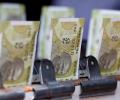
The Indian rupee rebounded 50 paise from its all-time closing low to settle at 96.36 against the US dollar, driven by retreating crude oil prices, signs of easing geopolitical friction, and likely central bank intervention.

Indian benchmark indices Sensex and Nifty closed lower, snapping a two-day rally, as a spike in crude oil prices, triggered by reports of fresh US military operations in southern Iran, dampened investor sentiment and reignited fears of renewed energy supply disruptions.

Governor: Simplistic narrative, questionable historical accuracy, underwhelming production quality, notes Sukanya Verma.

Coal and Mines Minister G Kishan Reddy announced that seven coal gasification projects will be established in Maharashtra, Odisha, and West Bengal with a Rs 64,000 crore investment, aiming to reduce India's reliance on energy imports.

As part of developing the derivative market in India, Reserve Bank of India has permitted the foreign currency-rupee options with effect from July seven, 2003.

The luxury carmaker plans to drive growth through local assembly of the MINI Countryman, expansion into 10 new cities and a broader product portfolio.

Delhi Police have arrested a suspected Lashkar-e-Taiba (LeT) handler, Shabir Ahmed Lone, in Delhi, uncovering a terror module with links to Pakistan's ISI. Lone is accused of running a network involved in pasting anti-national posters and planning terror activities across India.

India's forex reserves jumped by another $14.36 billion to a new all-time high of $723.77 billion during the week ended January 30, the Reserve Bank said on Friday.

The Indian rupee depreciated 20 paise to close at a fresh all-time low of 94.88 against the US dollar, driven by surging Brent crude oil prices, hovering around USD 115 per barrel, and persistent foreign capital outflows.
The Indian rupee plummeted to an all-time low of 95.80 against the US dollar, settling at 95.66, driven by elevated crude oil prices and escalating geopolitical tensions in West Asia, despite potential RBI intervention and import curbs on gold.
India's forex reserves jumped by $8 billion to an all-time high of $709 billion during the week ended January 23, the RBI said on Friday.

Faridabad police have arrested a husband and wife from Mumbai for allegedly defrauding people of approximately Rs 31 crore through fraudulent investment schemes in forex trading and film production.

Foreign Portfolio Investors (FPIs) have withdrawn Rs 14,231 crore from Indian equities so far in May, extending the total outflow for 2026 to over Rs 2 lakh crore, driven by persistent global macroeconomic uncertainties including inflation, interest rates, and geopolitical risks.

India's foreign exchange reserves jumped by $14 billion to $701 billion during the week ended January 16, the Reserve Bank said on Friday. The overall reserves had increased by $392 million to $687 billion in the preceding week.

India's forex reserves increased by $392 million to $687 billion during the week ended January 9, the Reserve Bank of India said on Friday.

'At the first sign of real trouble, that money will move. There will be a run.'

Compared with a year ago, the effective cost of studying abroad for Indian students has increased by roughly 10%-12% due to currency depreciation and rising living costs.

A Delhi court has ordered the confiscation of several properties belonging to UK-based arms consultant Sanjay Bhandari under the Fugitive Economic Offenders Act, following his declaration as a fugitive in a money laundering case.

Indian stock markets are set to be influenced by developments in US-Iran negotiations, crude oil prices, and foreign investor activity in the upcoming holiday-shortened week, according to market analysts.

Indian benchmark indices Sensex and Nifty experienced a significant slump in early trade, mirroring weak global trends, as escalating tensions in West Asia, particularly a drone attack on the UAE's Barakah nuclear facility, pushed crude oil prices higher. Track Sensex, Nifty50 movement and key market drivers for May 18, 2026.

The global artificial intelligence (AI) boom has significantly reshaped equity markets, with Taiwan surpassing India to become the world's fifth-largest stock market. India has seen its market capitalisation decline by 7% year-to-date, while AI-linked economies like Taiwan and South Korea have surged.

Gurugram Police have arrested three Nigerian nationals for allegedly defrauding people through social media platforms by posing as women. The police recovered mobile phones, a laptop, and SIM cards from the accused, who are also charged under the Passport Act and the Foreigners Act.

'With inflationary pressures now at elevated levels and the adverse cost environment persisting, the company has to pass on a portion of the increased costs to the market, while continuing to ensure that the impact on customers is kept to the minimum extent possible.'

The Indian rupee depreciated by 34 paise to close at 93.78 against the US dollar, marking its third consecutive session of decline. This fall is attributed to escalating crude oil prices driven by uncertainty surrounding US-Iran peace talks and fresh attacks in the Strait of Hormuz, alongside significant foreign institutional investor outflows from domestic equity markets.

The Delhi High Court has stated that the amount of interim maintenance for a spouse cannot be determined with mathematical precision, while hearing a case to enhance a woman's interim maintenance.

'You set up your SIPs and you do not touch them. Not during COVID, not during a war scare, not when your neighbour tells you the market is finished. You let the noise pass over you.' 'The beauty of this approach is that it does not require courage or conviction in the moment. It just requires inertia -- keep the SIP running and do not look at your portfolio too often.'

India's forex reserves dropped by $9.8 billion to $686.81 billion in the week to January 2, the Reserve Bank of India (RBI) said on Friday.

Despite reporting a weaker-than-expected net loss of Rs 2,536 crore for Q4FY26, largely due to a significant non-cash forex loss, analysts remain optimistic about IndiGo's long-term prospects, citing strong demand trends, a favourable pricing outlook, and strategic cost-control measures.

Bajaj Auto reported a significant increase in its consolidated Q4FY26 performance, with profit after tax more than doubling to approximately 3,662 crore, a 103 per cent year-on-year rise, primarily driven by record volumes, an improved product mix, and the strategic consolidation of Bajaj Auto International Holdings AG (BAIHAG).

The Indian rupee appreciated by 23 paise to settle at 92.91 against the US dollar, driven by a weakening American currency, retreating crude oil prices, and renewed foreign institutional investor (FII) inflows amid increasing hopes of easing geopolitical tensions.

India emerged reasonably well from 2025. But now, the oil shock and war-related supply disruptions have again driven funds out of India and significantly weakened the rupee, points out Ajay Chhibber.

'Once the currency goes out of the hand, then possibly your major challenge is that it will not come back.'

The measures announced by it risk backfiring, disrupting the foreign exchange market, and intensifying the very pressures they seek to contain, with broader consequences for the economy points out Rajeswari Sengupta.

The total reserves increased to $701.3 billion on the back of a rise in foreign currency assets which increased by $9.6 billion to $560 billion during the reported week.

Indian benchmark equity indices, the BSE Sensex and NSE Nifty, experienced a significant drop in early trade due to elevated oil prices, weak global market trends, and renewed fears of military operations in the Middle East following US President Donald Trump's statements regarding Iran. Track Sensex, Nifty on May 20.

The Indian rupee depreciated by 28 paise to settle at 93.44 against the US dollar, influenced by ongoing uncertainties surrounding West Asia peace negotiations, volatile crude oil prices, and the Reserve Bank of India's recent adjustments to non-deliverable forward market regulations.

India's forex reserves jumped by $3.29 billion to $696.61 billion in the week to December 26, the RBI said on Friday. The overall kitty had increased by $4.368 billion to $693.32 billion in the previous reporting week.
The Reserve Bank of India (RBI) announced that it processed 99.7 per cent of applications within the prescribed timeline under its Citizen's Charter in April 2026. The central bank handled a total of 21,150 applications, showcasing its commitment to efficient service delivery.

India's forex reserves jumped by $4.36 billion to $693 billion during the week ended December 19, the Reserve Bank said on Friday. The overall kitty had increased by $1.69 billion to $688.95 billion in the previous week.

Analysts predict that the ongoing US-Iran conflict, fluctuations in crude oil prices, and foreign institutional investor (FII) flows will be the primary factors influencing Dalal Street this week, with inflation concerns adding to investor anxiety.
